
So, you are forming an LLC and a lot of things point towards Wyoming. But is Wyoming really the right state for your LLC? Let's find out!
Wyoming just landed the top spot on the Tax Foundation's 2026 State Tax Competitiveness Index, the fifth year running it has held that ranking. The Equality State has a business-friendly reputation built over a decade. It offers some of the strongest privacy and asset protection laws in the country, with some of the lowest ongoing costs among the states. [1]
Still, no state fits every business, and Wyoming's advantages come with real tradeoffs. Before you file anything, it pays to know exactly what you gain and where Wyoming falls short.
That's why we built this guide to 7 real benefits of creating an LLC in Wyoming. This guide also covers the drawbacks, cost, and comparison with other states so you can decide with your eyes open.
7 Benefits of Forming an LLC in Wyoming
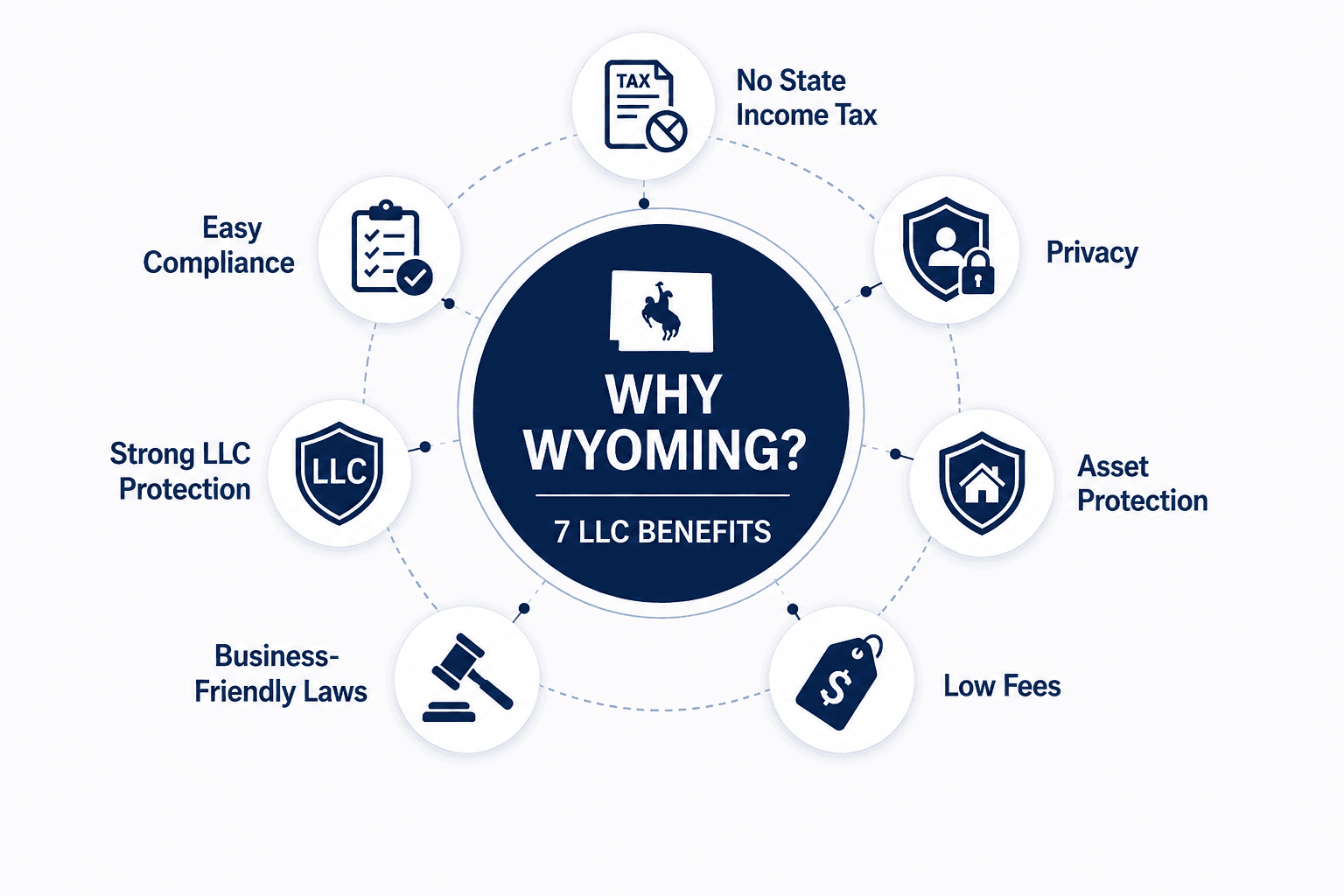
1. A Strong Small Business Growth Climate
Wyoming's small business base is both large and durable. Small businesses make up 98.9 percent of all Wyoming businesses, 81,924 in total, and they employ 135,636 people, or 65.2 percent of the state's workforce.
The state is not just heavy on small business; it keeps adding more. Between March 2023 and March 2024, small businesses opened 3,151 new establishments against 2,663 closings and added a net 1,494 jobs across the state. [2]
Longer term, the trend holds. Wyoming's small business employment grew 20.1 percent between 1998 and 2022, outpacing the national small-business employment growth rate over that same span. That mix of scale, steady formation, and long-run growth is a big part of why new owners keep choosing Wyoming.
2. Privacy and Anonymous Ownership
Wyoming does not require you to list LLC members or managers anywhere in your public state filing, according to the Wyoming Secretary of State's Articles of Organization requirements. Only your registered agent's name and address become part of the searchable public record. [3]
For a lot of owners, that matters more than it sounds like at first. It keeps your name off the marketing lists that scrape new business filings, makes it harder for a random person to tie your home address to your company, and gives you one less thing to worry about if a dispute ever turns personal.
Plenty of states publish member names by default, so this privacy protection is one of the clearer reasons Wyoming keeps coming up in conversations about where to form.
3. Charging Order Protection for LLC Owners
Most states only protect multi-member LLCs from aggressive creditor remedies, leaving single-member LLC owners more exposed. Wyoming is one of the smallest groups of states that extends full charging order (Wyoming Statutes § 17-29-503(g)) protection to single-member LLCs too.
In practice, that means if someone sues you personally and wins, Wyoming law limits what they can collect to the distributions your LLC actually pays out. Wyoming's statute goes a step further than most states by naming the charging order the sole remedy available and explicitly ruling out foreclosure. [6]
Remember this protection has limits. It will not cover fraud, personal guarantees, or situations where you mix personal and business money.
4. Zero State Income Tax and Franchise Tax
Wyoming charges no personal income tax, no corporate income tax, no franchise tax, and no gross receipts tax. That's a big part of why it topped the Tax Foundation's 2026 tax competitiveness ranking. Once your LLC's profits reach you, Wyoming doesn't take a cut at the state level, whether that's income or revenue.
This is where Wyoming pulls ahead of states that also skip income tax. Delaware doesn't tax non-resident LLC income either, but it still charges a flat $300 annual franchise tax. Nevada skips income tax too, then adds roughly $350 a year in combined fees. Wyoming doesn't replace one tax with another fee. Over five or ten years, that adds up to real savings.
However, this does not mean you don’t have other obligations. If you live in a state with its own income tax, your home state still reserves the right to tax the money you personally receive from your Wyoming LLC.
Also Read: How to Start an S Corp in Wyoming.
5. Low Cost to Form and Maintain
Wyoming's Articles of Organization cost $100 by mail or $103.75 online, and the Annual Report License Tax runs $60 minimum for most small LLCs, according to the Wyoming Secretary of State's filing fee schedule. Here is the full cost picture. [4]
Item | Cost | Frequency |
Articles of Organization | $100 mail, $103.75 online | One-time |
Annual Report License Tax | You pay the $60 minimum or $0.0002 for every $1 of Wyoming assets, whichever is greater | Annual |
Name reservation (optional) | $60 | One-time, holds name 120 days |
EIN | Free through the IRS | One-time |
To put these rates into perspective, Wyoming is considerably more affordable than other states. For example, Texas charges a $300 one-time formation fee, while Massachusetts requires a hefty $500 initial filing fee alongside a $500 annual report fee.
Wyoming offers a highly stable, long-term cost advantage for businesses looking to keep operational overhead low. A self-agent LLC with light Wyoming assets pays as little as $160 in year one and $60 a year after that.
6. The Longest LLC Legal Track Record in the Country
Wyoming is the birthplace of the American LLC. The state passed the nation's very first LLC statute back in 1977. To put that into perspective, Wyoming had a functional LLC framework nearly two decades before most other states adopted the structure at all. [5]
Because Wyoming courts have been handling LLC disputes for nearly 50 years, they have built a deep well of established legal precedents. When a legal issue or partnership dispute arises, attorneys and judges don't have to guess how to interpret a new, untested law. They can look at decades of stable prior rulings. For business owners, this extensive legal track record means fewer surprises in the courtroom and much more reliable asset protection.
7. Lifetime Proxy for Ownership Privacy and Continuity
Wyoming offers a legal arrangement where the member of a Wyoming LLC appoints another person or entity to act on their behalf in company matters for an indefinite period, typically for the life of the company or until revoked.
The proxy holder can appear as the public-facing signer on filings while the LLC's ownership remains with the original member, and the proxy holder does not gain equity or legal ownership rights unless specified.
Despite the name, the arrangement is revocable at any time, giving the owner flexibility to change it if circumstances change. It's a useful tool for owners who want a layer of privacy beyond the standard non-disclosure of members, or who want to build in continuity of control without probate involvement.
Wyoming LLC vs. Other States: Formation Cost Comparison
State | Formation Fee | Annual Fee/Tax |
$100 | $60 minimum | |
$90 | $300 flat franchise tax | |
About $425 combined | About $350 combined | |
$300 | $0 report fee (franchise tax applies above a revenue threshold) | |
$125 | $138.75 | |
$150 | $50 to $55 | |
$35 | $20 | |
$50 | $0 | |
$250 | Roughly $100, filed every two years | |
$70 | $800 minimum franchise tax |
Wyoming and Montana lead on raw cost, but Montana's low fees only pay off if you actually live and operate there, according to our state-by-state LLC filing fee comparison. If your business is location-flexible, Wyoming's mix of low fees, no income tax, and strong asset protection is hard to beat among this group.
5 Wyoming LLC Disadvantages You Must Know
1. Foreign Qualification Doubles Your Compliance Work
If you run a storefront, office, or warehouse anywhere other than Wyoming, you will likely need to register there too through a foreign qualification filing. That means paying Wyoming's fees plus your home state's registration fees, registered agent costs, and any taxes that state applies.
2. The Annual Tax Is Not Truly Flat
Wyoming's Annual Report License Tax is technically a small capital stock tax based on the value of assets located in the state, not a flat fee. Most small LLCs pay the $60 minimum, but the actual rate is $0.0002 for every $1 of assets you hold in Wyoming, whichever is greater. So an LLC holding $500,000 in Wyoming real estate or equipment would owe $100 instead of the $60 floor, and that number keeps climbing as your Wyoming-based assets grow.
3. Missed Filings Can Permanently Kill Your LLC
If you fail to pay your Annual Report License Tax within 60 days of the due date, Wyoming can administratively dissolve your LLC. Unlike states that let you revive a defunct LLC years later, Wyoming requires filing an entirely new LLC once dissolution happens.
Also Read: 15 Common LLC Mistakes to Avoid in 2026
4. Investors Generally Prefer Delaware
If you plan to raise venture capital or pursue an IPO, investors overwhelmingly expect a Delaware C Corporation rather than a Wyoming LLC. Converting later is possible, but it adds legal cost and complexity you can avoid by choosing the right structure up front.
Also Read: Delaware LLC vs Other States 2026: Pros, Cons, and Costs | Incorporating in Delaware: Pros, Cons, & Alternatives
5. Distance Can Slow Down Local Matters
Non-residents can own and run a Wyoming LLC without ever visiting the state, but that convenience has a tradeoff. If a legal or banking matter requires in-person or local handling, being far from Wyoming can add delay.
Ready to move forward? Our step-by-step guide to Starting a Business in Wyoming: 8 Essential Steps walks you through everything from naming your company to filing your formation paperwork.
Final Takeaway
A Wyoming LLC makes the most sense if your business is location-flexible, you want low ongoing costs, and privacy or asset protection matters to you. It makes less sense if you already operate physically in another state or plan to raise institutional funding. Weigh your actual operating footprint against Wyoming's benefits before you file.
Swyft Filings is a professional business formation company. Our business formation specialists have years of experience and can help you make the right choice.
Bibliography
- Tax Foundation. 2026 State Tax Competitiveness Index-Wyoming. Accessed July 24, 2026.
- SBA. 2025 Small Business Profile: Wyoming. Accessed July 24, 2026.
- Wyoming Secretary of State. Articles of Organization, Limited Liability Company. Accessed July 24, 2026.
- Wyoming Secretary of State. WyoBiz Online Filing Portal. Accessed July 24, 2026.
- Law.ua.edu.The Story of LLC’s. Accessed July 24, 2026.
- Wyoming Legislature. Wyoming Statutes § 17-29-503, Charging Order (Title 17, Limited Liability Companies). Accessed July 27, 2026.