

New U.S. Census Bureau data shows solopreneur filings jumped 31% year over year in May 2026, now accounting for 72% of all new business applications. Here's what the numbers mean for founders thinking
The latest data from the U.S. Census Bureau tells a clear story: more Americans are starting businesses than ever, and the growth is being driven by people going solo.
In May 2026, new business applications climbed 17% year over year. But underneath that headline is a sharper trend. The fastest-growing slice of the market isn't companies gearing up to hire and run payroll. It's individuals betting on themselves.
The Numbers
Solopreneur filings — applications from founders building one-person businesses rather than employer companies — grew 31% year over year. That's 89,000 more solo businesses started this May than the same month a year ago.
These founders now make up 72% of all new business applications, up from 64% just twelve months earlier. Meanwhile, applications from likely employers actually declined 7.8% over the same period.
The takeaway: the market is growing, and it's growing one-person-business first.
Why It's Happening
The barriers to starting a business have never been lower. Software, payments, marketing, and fulfillment that once required a team and real capital are now a few subscriptions away. A freelancer can invoice globally on day one. A side hustle can reach customers without a storefront. A first-time founder can form a real, legitimate business in an afternoon.
That shift shows up in the data as a wave of solo founders: freelancers turning skills into companies, side hustles becoming full-time, and first-time entrepreneurs deciding they'd rather build their own thing than wait for permission.
What It Means for Founders
If you're one of the people thinking about making the leap, the data is on your side. You're not an outlier — you're part of the largest cohort of new business owners in the country.
But going solo doesn't mean going it alone on the details that matter. Forming the right entity, staying compliant, and keeping your business in good standing are what separate a real company from a good idea. That's the part Swyft Filings exists to make fast and simple, so you can spend your energy on building.
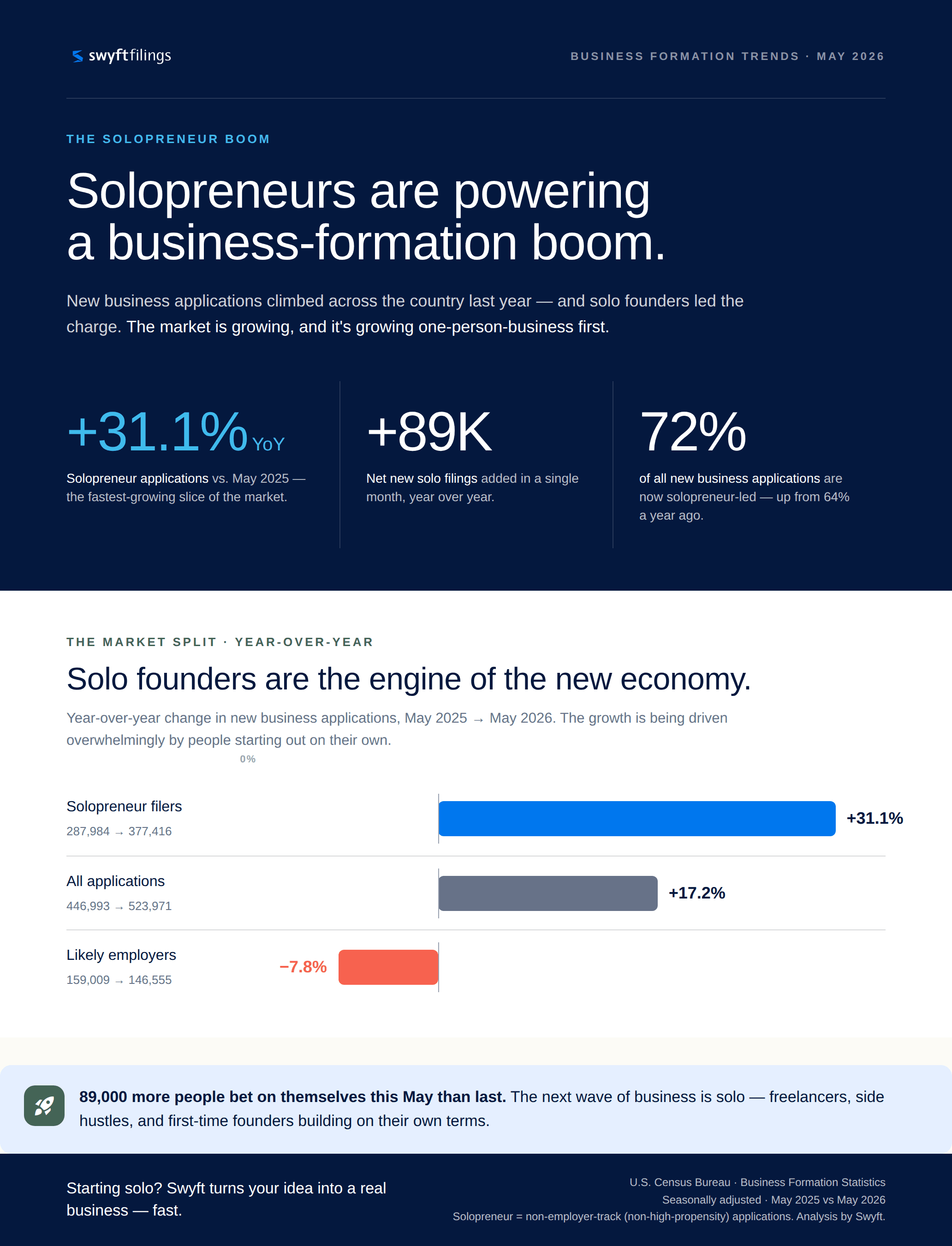
Source: U.S. Census Bureau, Business Formation Statistics, May 2026. Figures are seasonally adjusted and compare May 2025 to May 2026. "Solopreneur" refers to non-employer-track (non-high-propensity) business applications as defined by the Census Bureau; analysis by Swyft Filings.